
Reviewed · VIKING HISTORY TOURS
Private Tour: 3h Viking History from Stockholm to Runic Kingdom
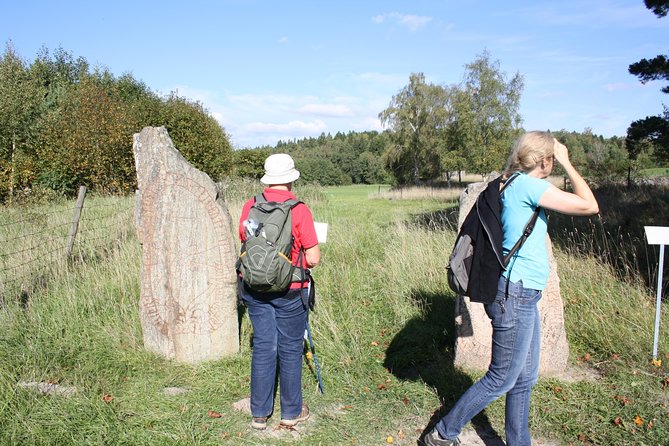
The most revealing part of this tour is not a museum display, but a Viking grave field and rune stones in their original countryside settings. From Stockholm, you ride into Täby and Vallentuna to see the places where people raised monuments, held assemblies, buried their dead, and marked their power.
I like the private car and guide, which keep the three-hour visit smooth and personal. I also like the mix of sites: Estrid’s family monuments, Jarlabanke’s long bridge, a Viking law court, and a medieval church. The main consideration is time. With about an hour spent driving, the stops are rewarding but fairly short, and anyone hoping for a large archaeological site may find the experience modest.
Key points to know before booking
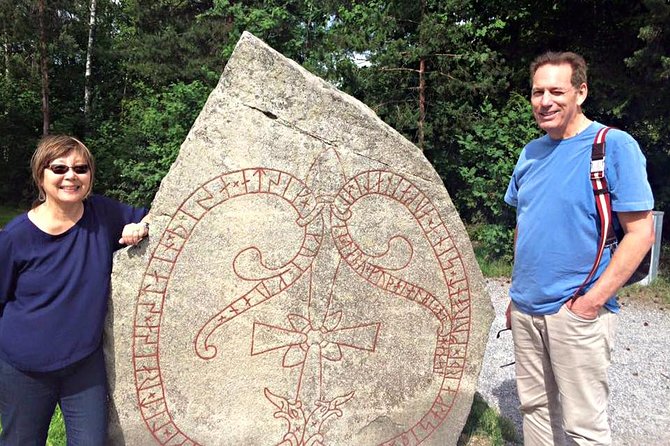
- Estrid’s grave field: See an early Christian Viking burial ground with more than 20 skeletons and rune stones linked to a powerful woman.
- Jarlabanke’s 150-meter causeway: Walk across the bridge built by one of the area’s most self-assured Viking lords.
- Arkils tingstad: Learn how local leaders met to settle law, order, insults, divorce, and violence.
- A private three-hour outing: Your group travels in a private vehicle with pickup and drop-off included in central Stockholm.
- A guide-led experience: Guides including Olof, Charlotte, Erik, Karl, Angus, and Quentin have been praised for clear explanations and warm conversation.
- A countryside break from Stockholm: The tour gives you ancient monuments, rural views, and a look at places rarely covered by a standard city tour.
Why this short Viking tour works
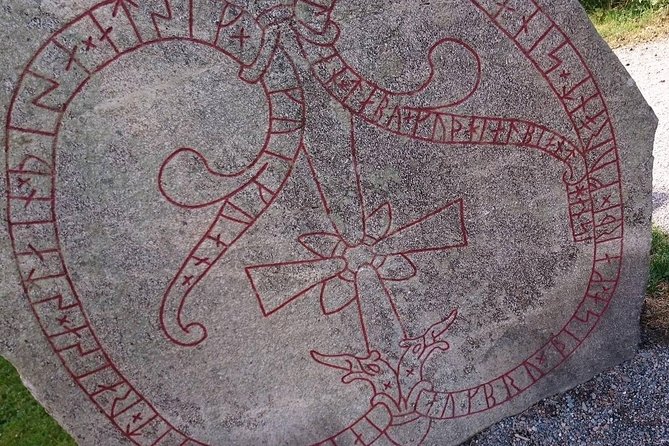
Stockholm is full of museums, but museum stones can feel strangely quiet. Here, the runes remain beside old roads, fields, water, and church grounds. You see how the monuments fit into the places where people lived and traveled.
The subject is also broader than battles and ships. Your guide explains family ties, burial customs, clothing, daily life, mythology, Christianity, law, and social rank. That wider view matters because the Viking Age was not simply a parade of raiders. It was a working society with farms, assemblies, legal rules, religious change, and ambitious local leaders.
The private format is a real advantage. You can ask why a rune stone was raised, how the letters were carved, or what a particular phrase means without waiting for a large group to catch up. Guides have included Olof, Charlotte, Erik, Karl, Angus, and Quentin. The guide assigned to your date may be different, but the experience depends heavily on that person’s ability to explain the stones and connect them to the wider story.
Expect a conversational outing rather than a formal lecture. One guide may focus on archaeology, another on the rune texts, and another on local geography and Swedish history. Several guides have been praised for answering questions, adjusting the pace, and suggesting places to visit afterward. One guide even added a stop in Sigtuna for a group, while another helped guests continue their day at Stockholm City Hall or the Stockholm History Museum. Those extras are not guaranteed, but they show the flexibility a private tour can offer.
More Viking-age Stockholm:
- Stockholm: The Viking Museum Exhibition and Viking Ride
★ 4.5 · 667 reviews - Entrance ticket to The Viking Museum
★ 4.0 · 301 reviews - Viking History, Runes & Countryside 9h Tour to Sigtuna & Uppsala
★ 4.5 · 283 reviews
The 9:30 a.m. pickup and ride to Täby
The tour begins at 9:30 a.m. Pickup is available from hotels, cruise ports, and other accommodations within five kilometers of Stockholm Central Station. You travel in a private vehicle with the guide or driver, depending on the arrangement, and return to your hotel at the end.
The drive to the Viking sites takes roughly 30 minutes, with another 30 minutes for the return journey. Traffic can change those times. That leaves about two hours at the sites, so the schedule is compact. You will not spend half a day wandering through one large archaeological park. Instead, you get four focused stops, each with a different purpose.
This ride is part of the experience. As Stockholm gives way to quieter areas around Täby and Vallentuna, your guide can explain how people moved through the area and why rune stones were placed along roads, bridges, burial grounds, and meeting places. Charlotte, for example, has been praised for giving a useful introduction to the natural setting before explaining the stones. That sort of context makes the carved messages easier to understand.
If you are arriving by cruise ship, check your pier before booking or reconfirming. Pickup instructions differ for Stadsgården, Frihamnen, and Värtahamnen. At the named piers, your guide waits outside the relevant terminal or near the tourist buses with an A4 sign marked Viking Tours. Nynäshamn is different: pickup is not included there, since the port is about 50 kilometers from central Stockholm. You need to arrange a central meeting point and reach it by train or cruise bus.
Stop one: Estrid’s grave field in Täby
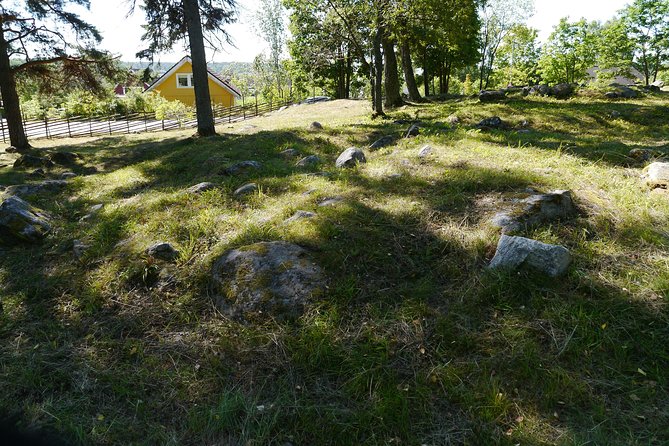
The first stop introduces Estrid, one of the most memorable figures on the route. You see a grave field with more than 20 skeletons, along with several Viking monuments and rune stones connected to her family.
Estrid was a powerful Viking woman, and the stones she raised preserve the names and memories of people close to her. This gives the site a more personal feel than a general discussion of Viking warriors. Instead of hearing only about kings and raiders, you learn how family, inheritance, faith, and public reputation shaped the age.
The area also offers a chance to discuss the shift from older beliefs toward Christianity. The grave field is described as an early Viking Age Christian burial site, and the nearby monuments help show how people could hold onto older customs while new religious ideas took root.
Your guide may point out where Estrid’s possible farm once stood, though the viewing is from a distance. Her skeleton was found at this site, which adds an unusual human connection to the visit. You can also ask about clothing, work, food, and ordinary routines. The stop lasts about 40 minutes, and admission is included.
The limitation is that this is an open historical site, not a polished museum. You will see stones, earth, and markers rather than reconstructed houses or a full collection of objects. That is exactly what some people want. If you prefer dramatic interiors and many artifacts, you may need to pair this tour with Stockholm’s History Museum.
Stop two: Jarlabanke’s bridge and its rune messages
Next comes Jarlabanke’s bridge, a long causeway associated with the Viking lord Jarlabanke. The route describes it as about 150 meters long and dating to around 1030.
Walking across or beside the causeway gives you a clear sense of how a powerful landowner could shape movement through the area. This was not just a decorative monument. A bridge or causeway helped people cross difficult ground, while the rune stones announced who had paid for it and who deserved to be remembered.
Jarlabanke comes across as unusually confident. The stones carry his message, his name, and his public image. Your guide explains the wording and the way the monuments present him as a man of authority. Angus has been praised for reading the runes and explaining them in their original setting, which is especially useful here.
Allow about 20 minutes for this stop. That sounds brief, but the bridge is straightforward to explore, and the guide’s explanation does most of the work. Wear shoes that are comfortable on uneven outdoor ground, especially if the weather is wet.
Do not expect a towering stone structure like a Roman bridge. The appeal is scale, location, and meaning. You are following an old route and reading a medieval power statement in the place where it was made.
More of the past around Stockholm:
- Stockholm: Ghost Walk and Historical Tour
★ 4.7 · 2,206 reviews - The Original Stockholm Ghost Walk and Historical Tour – Gamla Stan
★ 4.5 · 1,165 reviews - Stockholm: Old Town Historical Walking Tour
★ 4.9 · 344 reviews - Viking History and Swedish Countryside Tour to Sigtuna & Uppsala
★ 4.5 · 162 reviews
Stop three: Arkils tingstad, where law was a public matter
Arkils tingstad is perhaps the most distinctive stop for anyone interested in how Viking society functioned. It was an assembly place, or thing site, where local leaders met to discuss law and order and decide matters affecting their people.
Your guide explains the tribal system and the practical rules that governed community life. Topics include divorce, killing in response to insults, and the enforcement of law. These details can make the period feel surprisingly immediate. People argued over family, reputation, property, and violence much as communities have done in every age, though the remedies and penalties were different.
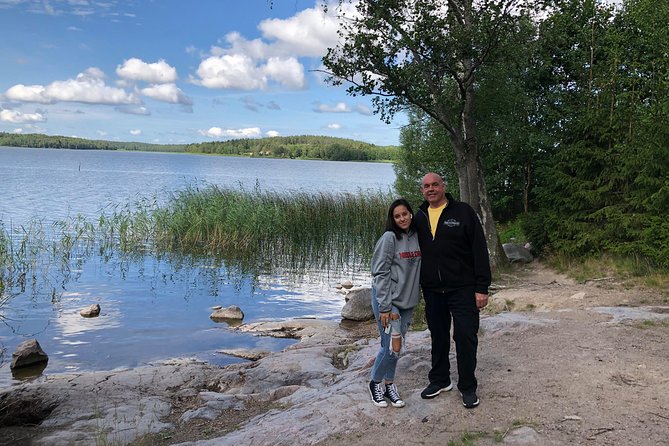
The meeting place is preserved beside a lake, giving the stop a quieter setting than the road monuments. You have about 30 minutes here. Take time to look at the stones and listen for how the site’s location supported public gatherings.
This is also where the tour moves furthest beyond popular Viking stereotypes. The central question is not who won a raid, but who had the right to make decisions and how a community kept order. If you enjoy social history, this may be the strongest stop on the route.
The site will not offer a long indoor presentation or many objects to examine. Its value comes from the guide’s storytelling and the physical setting. Ask questions. In a private group, you can spend more time on law, politics, or mythology if those subjects interest you.
Stop four: Vallentuna church and a changing Sweden
The final stop is Vallentuna Church, a 13th-century building with more links to Jarlabanke and the area’s rune tradition.
Inside, you see a plain, reformed church room that contrasts with the vivid painted interiors associated with Sweden’s Catholic past. That change gives the stop a useful second layer. You are not only looking at a medieval church. You are seeing how religious spaces were altered as Swedish society moved through the Reformation.
The church also preserves stone-mason signatures from the building period. These marks can seem small, but they remind you that medieval construction depended on skilled workers whose names were rarely recorded in the grand histories.
One of the most unusual details is the first known written Swedish ending rhyme, found in the church. Your guide can place it within the development of written Swedish and explain why a short inscription matters. The stop lasts about 30 minutes and admission is included.
This is a good final stop because it connects several threads: rune writing, Christianity, medieval buildings, language, and local power. It also changes the mood. After outdoor stones and assembly grounds, you step into a church where later generations reshaped the religious world.
What the private format adds
A private tour is not automatically better, but here it solves several practical problems. You do not need to match the pace of a bus group, and you can ask for more detail at the sites that interest you most. A family with children can focus on myths and dramatic stories, while a history-minded couple can spend more time on rune wording, burial customs, or the legal system.
The experience has worked for groups of two, families with 11-year-old children, and larger family parties. The minimum booking is two people. Most people can participate, and service animals are allowed.
The guide can also shape the rest of your Stockholm day. Suggestions have included the Stockholm History Museum, City Hall, and additional local sights. Do not count on an extra stop, since the advertised duration is about three hours, but it is worth asking your guide for advice before the return drive.
The strongest guide experiences have combined subject knowledge with warmth. Olof, Erik, Angus, Quentin, Charlotte, Karl, and others have been praised for making the past understandable and answering questions patiently. One poor experience involved a guide who spoke very little, so the quality can vary. That is the main reason to communicate your interests clearly when you book or reconfirm.
Is $431.94 per person a fair price?
At $431.94 per person, this is expensive if you compare it with a self-guided outing or a city museum ticket. The price makes more sense for a small group that values door-to-door transport, a private guide, and a tightly planned route beyond central Stockholm.
Your fee includes the guide, driver and vehicle, taxes, surcharges, and pickup and drop-off within the stated central area. There are no extra admission fees at the four listed stops. For two people, the total cost is substantial. For a family or group splitting the private vehicle, the per-person value improves.
You are paying for time saved as much as for entry. Reaching four outlying sites by public transport would require planning and connections, and a private vehicle keeps the three-hour schedule practical. Still, the tour is not a bargain for someone who only wants to glance at a few stones.
I would choose it if Viking-era Sweden is a priority and you want explanation in the field. I would skip it if you want a large museum collection, a reconstructed Viking village, or a full-day archaeological program.
Practical details before you go
The tour is offered in English and uses a mobile ticket. Confirmation is provided at booking, and the exact hotel pickup time is reconfirmed if needed. If your accommodation is too far from central Stockholm, you receive another meeting point that is easier to reach.
The tour is normally booked well ahead, with an average booking lead time of about 103 days. That does not mean you must book exactly that early, but it suggests planning ahead for a particular cruise date or travel season.
Free cancellation is available until 24 hours before the start time. Cancellations or changes made inside that 24-hour window are not refunded or accepted. The minimum group size is two people.
Bring comfortable walking shoes and clothing suited to outdoor stops. Much of the experience takes place beside grave fields, stones, roads, and a lakeside assembly area. The route is not described as fully wheelchair accessible, so ask the provider about your specific needs before booking.
Should you book the Runic Kingdom tour?
Book this tour if you want to see real rune stones in their original settings, understand how Viking communities handled law and family life, and enjoy the ease of a private car from Stockholm. It is especially useful for cruise passengers with a morning free, families who want a flexible guide, and people who find museums more meaningful after seeing the places behind the displays.
Think twice if you need constant visual drama or a large number of artifacts. The sites are spread out, the driving takes about an hour, and some stops are quiet fields or modest monuments. For the right audience, that is the point: this is a close look at local Viking life, not a staged show.
FAQ
How long is the private Viking tour?
The experience lasts approximately three hours, including the drive from Stockholm to the sites and the return journey.
What time does the tour start?
Pickup begins at 9:30 a.m.
Is hotel pickup included?
Yes. Pickup and drop-off are included for central hotels, ports, and other accommodations within five kilometers of Stockholm Central Station.
Can I be picked up at Nynäshamn Harbour?
No. Pickup is not included at Nynäshamn Harbour. You need to arrange a meeting point in central Stockholm and reach it by train or cruise bus.
Which Viking sites does the tour visit?
The route includes a grave field in Täby, Jarlabanke’s runestones and bridge, Arkils tingstad, and Vallentuna Church.
Is transportation private?
Yes. The tour includes private round-trip transportation and is limited to your group.
What is the minimum number of people needed to book?
At least two people are required to book the tour.
Is the tour offered in English?
Yes. The tour is offered in English and includes a mobile ticket.
What is the cancellation policy?
You can cancel up to 24 hours before the start time for a full refund. Cancellations or changes made less than 24 hours before the start time are not accepted for a refund.
Just added around Stockholm
- World War II Stockholm Old Town Walking Tour and Army Museum★ 4.6 · 4 reviews
- Vaxholm & Stockholm Archipelago: Guided Excursion, Day Trip★ 4.8 · 41 reviews
- Stockholm: Archipelago Guided Boat & Walking Tour of Vaxholm★ 3.1 · 23 reviews
- Wolf and Wildlife Tracking in Sweden★ 5.0 · 9 reviews
- Scandinavian Art, Architecture and Design Tour in Stockholm★ 4.5 · 11 reviews
- Drottningholm Palace Private Guided Tour★ 4.5 · 15 reviews
- Walking Tour of Stockholm’s City Center★ 4.5 · 26 reviews
- ROYAL Castle Skokloster and Viking Sigtuna (private tour)★ 4.5 · 3 reviews
Viking History Tours, compared.
Viking History, Runes & Countryside 9h Tour to Sigtuna & Uppsala
Read our review →
Stockholm Viking History Full Day Tour to Sigtuna + Uppsala
Read our review →
Viking History Small Group Tour from Stockholm: Half Day Including Sigtuna
Read our review →

Full Day Viking Tour with Fika Swedish Coffee Break
Read our review →Browse the lists this tour appears in