
Reviewed · ARCHIPELAGO CRUISES
Guided 5-Day Kayak & Wildcamp the Archipelago of Sweden
Sweden’s Saint Anna Archipelago is the sort of place where the map becomes a maze of pine-covered islands, bare skerries, narrow channels, and open sea. This five-day trip lets you travel through it by kayak, sleeping wild beside the water rather than returning to a hotel each night. The small group, capped at eight, is a major strength. You get a personal outdoor trip without the feel of a large organized party.
I especially like that all serious gear is included, from quality kayaks to camping and cooking equipment. The other big plus is the food: breakfast, lunch, snacks, dinner, coffee, tea, soft drinks, and bottled water are covered, so you can focus on paddling and camp life. The main caution is the physical commitment. Some days are long and exposed, and weather may change the route, especially around Häradskär Lighthouse.
Key things to know before you book
- The group never exceeds eight people, making it easier to get help with paddling, packing, navigation, and camp chores.
- Häradskär Lighthouse is weather dependent, since reaching it requires an exposed crossing on the open sea.
- Harstena brings a welcome change of pace, with a village walk, museum visit, and cinnamon buns from the bakery.
- All meals and outdoor equipment are included, a useful saving on a remote camping trip.
- Pickup begins in Norrköping at 10:00 a.m., with collection from the train station or a local hotel or hostel.
- The route is designed for adults, with a minimum age of 18 and a maximum of eight participants.
Why this Swedish archipelago trip is different
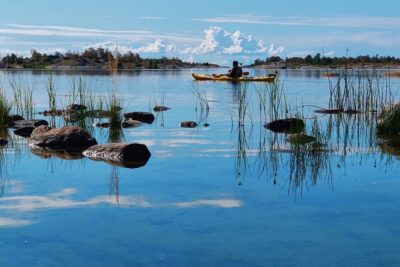
The Saint Anna Archipelago is not one single island destination. It is a wide scatter of islands and islets along Sweden’s eastern coast, with sheltered inner channels and rougher outer waters. From a kayak, you travel at the level of the rocks and reeds, close enough to notice birds on small skerries and old pines growing from smooth granite.
That makes this trip feel less like a sightseeing cruise and more like a moving camp. You load your kayak in the morning, paddle for several hours, stop for food or a short walk, and look for a good place to camp before evening. The guides handle route planning and help the group find sheltered sites, but you remain involved in the basic work of outdoor travel.
The small group matters here. Eight people is enough for a social campfire-style atmosphere, but still small enough for the guide to keep an eye on the group. It also reduces the usual problems of a large outdoor tour, such as waiting for a long line of paddlers or struggling to hear instructions.
Other trips out into the islands from Sweden:
- Stockholm: City Archipelago Sightseeing Cruise with Guide
★ 4.3 · 10,798 reviews - Stockholm: Archipelago Boat Tour
★ 4.4 · 3,110 reviews - Stockholm Archipelago Cruise with Guide
★ 4.0 · 1,125 reviews
Day 1: Loading kayaks and reaching Aspöja
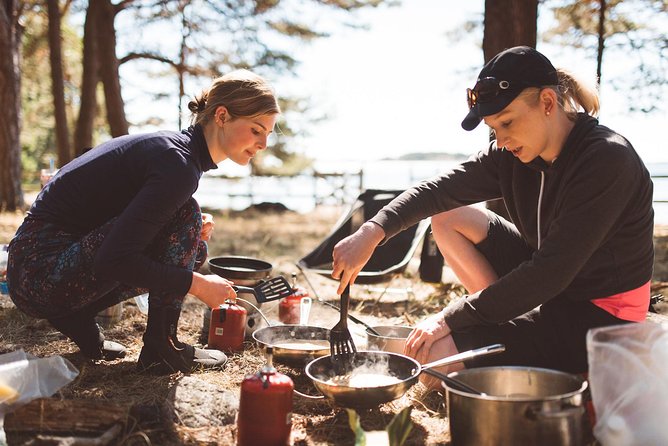
Your day starts in Norrköping, where pickup is scheduled for 10:00 a.m. Transport takes you to the launch area in Saint Anna, where the kayaks, food, water, dry bags, camping gear, and cooking equipment are ready.
You repack your clothes into dry bags and load the kayaks. This is a useful part of the trip, not just a formality. You learn how your equipment is arranged, what needs to stay dry, and how much space you really have for personal belongings.
The launch site sits in a sheltered bay. At first, the paddling is protected and manageable, but soon the route opens into a maze of islands. The first two hours give you time to get comfortable with the kayak before the route becomes more demanding.
As you paddle northeast toward Aspöja, you pass forested islands and small islets. The area is good for bird watching, with ducks, swans, and grey herons. White-tailed eagles are also seen regularly because they nest in nearby large trees.
A break in the Uggelholmarna Nature Reserve adds a bit of walking to the day. Three-hundred-year-old pine and linden trees grow there, and the open woodland makes it a pleasant place to stretch your legs. You then head toward the narrow inlet between Lammskär and Kalvskär.
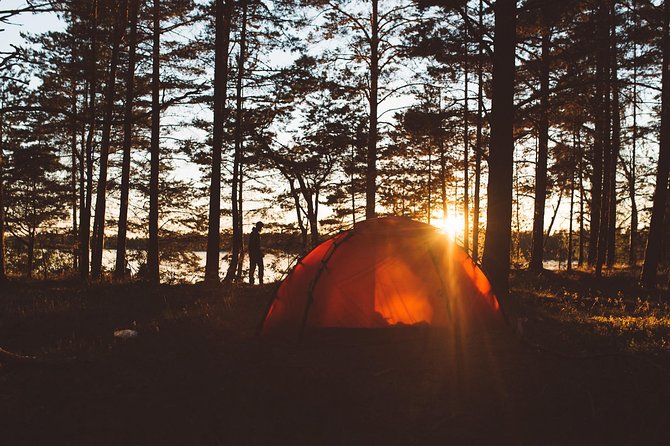
The first night is near the islets south of Aspöja, one of the most scenic parts of the route. This setting is especially appealing at sunset, when the islands and open water take on a much softer look. The first day is long, but it gives you an immediate sense of how the trip works: paddle, explore, eat, and make camp in a new place.
Day 2: Open water, birds, and Kupa Klint
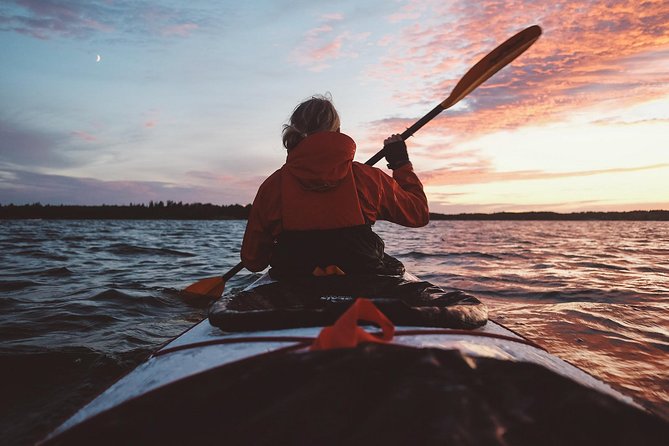
Day two takes you southeast through the outer archipelago. The character changes quickly. Instead of mostly sheltered forested islands, you encounter low, wind-shaped islets and a broad blue horizon.
This is one of the more strenuous paddling days. The open water can feel exposed, and the route depends on conditions. You might see seals, and the birdlife is a major part of the experience. The area is home to gulls, Arctic terns, black guillemots, mergansers, velvet scoters, eiders, shelducks, oystercatchers, and redshanks.
Larger birds are also common. White-tailed eagles and great cormorants may appear, along with the possibility of Arctic skuas and ospreys. You should bring patience and keep your expectations sensible. Wildlife sightings are possible, not guaranteed, and the real reward is the feeling of moving quietly through a living coastal environment.
After the day’s paddle, you reach Kupa Klint, a navigation mark and lookout with broad views over the Missjö Archipelago. From here, hundreds of skerries spread below you. It is one of the strongest viewpoints on the route, especially after several hours at water level.
The group then moves inside the outer band of skerries toward the larger island of Missjö. The guides know the small channels and sheltered coves, which is valuable after a demanding day. A good campsite is not just about beauty. It also needs protection from wind, room for tents, and a safe place to organize food and equipment.
Day 3: Harstena village and a night by the open sea
Day three brings a change from remote island travel. You paddle south toward Harstena, the most visited island in this part of the archipelago. The approach through a narrow inlet gives you an attractive view of the village.
Harstena is known for its historic character and picturesque setting. You can visit the museum in the old school, walk through the village, and stop at the bakery for cinnamon swirls. This is one of the trip’s most enjoyable contrasts: after two days of outdoor routine, you get a glimpse of settled island life without leaving the water-based journey behind.
The visit also gives you a chance to walk more than you do on a normal paddling day. If your shoulders need a break, that matters. Kayaking can feel gentle at first, but repeated hours of paddling use the upper body in ways you notice by the third day.
After Harstena, you head southeast toward Ytterö. The island has smooth rocky beaches, old pines, and a more exposed position on the open sea. The guide looks for higher ground where you can see across the archipelago and toward the horizon.
This is a quiet camping night. The sound of waves against the rocks replaces road noise, and birds call from the nearby islets. You should expect a simple night rather than resort comfort. The appeal is the setting, not beds, showers, or electrical outlets.
Other paddles around Sweden:
- 1-Day Small-Group Stockholm Archipelago Kayak Tour
★ 5.0 · 266 reviews - Stockholm City Kayak Tour
★ 5.0 · 194 reviews - Stockholm: Guided Kayak City Tour & Optional Midsummer Meal
★ 4.6 · 170 reviews - Stockholm: Winter Kayaking, Swedish Fika and hot Sauna Experience
★ 5.0 · 156 reviews
Day 4: The exposed crossing to Häradskär
Day four is the most weather-sensitive part of the route. The aim is Häradskär, home to an old red iron lighthouse at the outer edge of the archipelago. Reaching it depends on sea and wind conditions, so the guide makes the final decision.
You pass Gubbö, where a climb gives you a high view over this section of the islands. Then you paddle south through the groups of islands around Laxvarp. From there, the group assesses whether an exposed crossing to Häradskär is sensible.
That judgment is one reason a guided trip is useful. The lighthouse is a memorable goal, but it is not worth taking an unsafe route. If conditions allow, you cross toward the lighthouse and arrive at a stark, open setting where the main sounds are birds and waves striking the flat rocks.
Häradskär feels like the farthest point from ordinary daily life on this trip. It is not a polished attraction with a long list of facilities. Its appeal comes from its position at the edge of the open sea and the effort required to reach it.
You should treat this day as a possible highlight rather than a guaranteed stop. A route change caused by weather is part of responsible kayaking, not a failure of the tour.
Day 5: Fångö copper mine and the paddle back
The final morning begins at a campsite south of Fångö. After breakfast and a last swim, you start the return journey.
The route includes a visit to the abandoned copper mine on Fångö. This adds a human story to a trip otherwise shaped by rocks, birds, water, and weather. You then round the island and paddle through a small canal opposite Fyrudden.
From there, it is a short paddle west to the mainland finish point. The last day is listed at about six hours, so you still have a full morning and early afternoon on the water rather than a rushed pack-up and immediate transfer.
By this point, the group has spent five days sharing navigation, meals, weather, packing, and camp duties. That shared rhythm is part of the value. You arrive back at the mainland not only having visited remote islands, but having learned how to function as a small paddling crew.
What is included, and why it affects the price
The price is $1,629.22 per person. That is not a cheap weekend outing, but the comparison needs to include what you would otherwise have to rent, buy, transport, and organize.
The package includes an experienced kayaking guide, high-quality kayaks, camping gear, cooking equipment, dry-bag packing support, return transport between Norrköping and Saint Anna, and a detailed guidebook. It also covers five breakfasts, five lunches, five dinners, snacks, coffee, tea, soft drinks, and bottled water.
Food can become a surprisingly awkward part of a remote camping trip. You need enough calories, safe storage, cooking equipment, and a plan for resupply. Here, those jobs are handled as part of the trip. The included gear is also valuable because high-end kayaking and camping equipment can be expensive to purchase for one trip.
The package does not include flights, your transfer to Norrköping, or alcoholic drinks. You need to arrange the journey to the pickup point yourself. From Stockholm Skavsta Airport, a shuttle takes about 55 minutes to Norrköping. From Arlanda, a direct train takes about two hours. Linköping Airport is about a 25-minute train ride from Norrköping, while Norrköping Airport is about a 10-minute taxi ride into town.
Food, comfort, and group life
The food is one of the strongest parts of the package. The trip includes every main meal, snacks, and several nonalcoholic drinks. The praise for the cooking is unusually strong, with the food described as exceptionally good, even by someone who also praised the equipment and guides.
You should still remember that this is wild camping. Meals are prepared outdoors, and your comfort depends on weather, camp setup, and your willingness to help with the routine. The tour removes much of the planning burden, but it does not turn the trip into a hotel stay.
The group size keeps social life manageable. With eight people at most, you have a fair chance to get to know everyone, and the guide can offer direct help. One guide, Rob, receives special thanks by name, which suggests that personal support is an important part of the company’s approach.
The experience is also suitable for a beginner according to the available feedback, but beginners should not confuse that with effortless. You need to be ready for long days, repeated paddling, carrying or loading gear, and sleeping outdoors.
Who should book this kayaking trip?
I would choose this trip if you want a serious nature holiday without having to own a kayak or plan every meal and campsite. It suits adults who enjoy quiet scenery, bird watching, simple camp life, and a physical challenge.
It is also a good match if you want a small social group rather than a private trip. The eight-person limit gives you companionship while preserving the sense of being far from crowds.
I would think twice if you need predictable weather, fixed indoor accommodation, or a low-effort sightseeing schedule. The route includes open-water paddling, and the most ambitious stop depends on conditions. The $1,629.22 price also makes more sense if you value the included equipment, meals, guide, and transport. If you already own a full set of quality gear and prefer to organize your own food, the package may feel less attractive.
Booking is flexible up to 24 hours before the start time, when a full refund is available. The experience is offered in English, and confirmation is provided at booking.
Should you book the five-day archipelago adventure?
Book it if you want to explore Sweden’s coast at paddling speed, sleep beside the sea, and let a guide handle the route, equipment, food, and camp planning. The strongest reasons are the tiny group, excellent included gear, generous meal plan, and access to places such as Ytterö and Häradskär that are difficult to reach casually.
Skip it if you want a relaxed hotel holiday or dislike exposed water and outdoor routines. For the right person, though, this is a well-supported way to experience the Saint Anna Archipelago without turning the trip into a major logistical project.
FAQ
How long is the kayaking and wild-camping tour?
The tour lasts approximately five days.
Where does pickup take place?
Pickup is in Norrköping at 10:00 a.m., either at the train station or at a hotel or hostel.
Is transport to the kayaking area included?
Yes. Return transport between Norrköping and Saint Anna is included.
What equipment is provided?
The tour provides kayaking, camping, and cooking gear, along with bottled water and a detailed guidebook.
Are meals included?
Yes. The package includes five breakfasts, five lunches, five dinners, snacks, coffee, tea, soft drinks, and bottled water.
Is the tour offered in English?
Yes. The tour is offered in English.
How many people can join the group?
The maximum group size is eight people.
What is the minimum age?
The minimum age is 18.
Is Häradskär Lighthouse guaranteed?
No. The visit depends on weather and sea conditions, since reaching the lighthouse requires an exposed crossing.
Just added around Sweden
- Gothenburg: Alfie Atkins Cultural Centre Admission Ticket★ 4.2 · 12 reviews
- GOT Gothenborg Landvetter Airport: Vinga Lounge Access★ 3.5 · 52 reviews
- From Stockholm: Archipelago Hike to Landsort Lighthouse★ 5.0 · 26 reviews
- Stockholm: Sigtuna and Uppsala Viking History Day Tour★ 4.7 · 41 reviews
- Private Golden Hour Photo Walk in Stockholm★ 5.0 · 3 reviews
- Premium Aurora Snowmobile Ride With Panoramic Views★ 4.9 · 42 reviews
- From Abisko: Kärkevagge Valley & Trollsjön Lake Guided Tour★ 5.0 · 4 reviews
- Experience the majestic Auroras Kiruna-Abisko & lodge dinner★ 5.0 · 23 reviews
Archipelago Cruises, compared.
City Archipelago Sightseeing Cruise with Guide
Read our review →
1-Day Small-Group Stockholm Archipelago Kayak Tour
Read our review →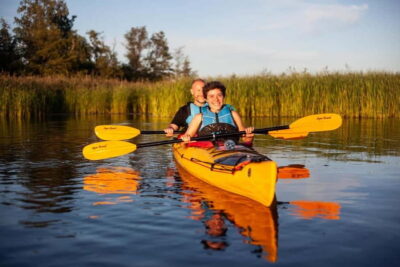
Archipelago Islands Kayak Tour and Outdoor Picnic
Read our review →
Browse the lists this tour appears in