
Reviewed · OLD TOWN AND GAMLA STAN WALKS
Stockholm Must See – Old Town, boat + Vasa Museum 3h small group
The Vasa is the star here: a 17th-century warship that sailed only about 1,200 meters before sinking, then spent centuries underwater before being raised with about 98 percent of its original wood. This tour gives you that remarkable story after a guided walk through Stockholm’s Old Town and a ferry ride to Djurgården.
I like the compact route and the way a local guide connects royal history, medieval trade, executions, and modern Swedish life. I also like the ferry crossing, which gives you a quick look at Stockholm from the water instead of keeping you on city streets all day.
The main caution is time. Three hours moves quickly, and the 4:00 p.m. departure can leave only about 50 minutes to an hour inside the Vasa Museum before closing in the low season. The morning departure is the better choice if the ship is your priority.
Key points to know before booking
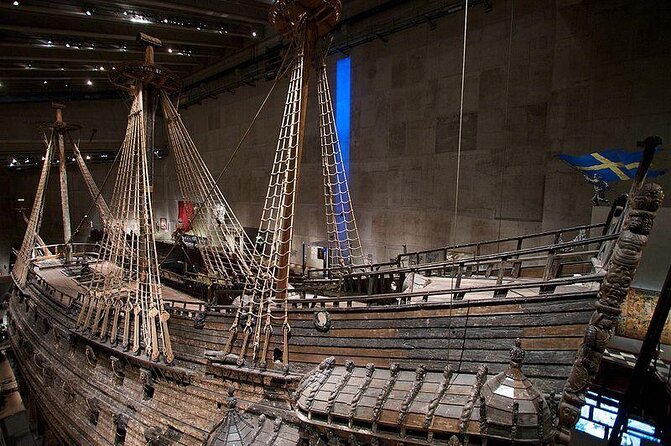
- The Vasa Museum is the grand finale: You see one of the world’s most unusual preserved ships, with a guide explaining why it sank and how it survived.
- The Old Town walk is story-led: Expect Stortorget, the Royal Palace area, medieval lanes, Riddarholmen, and the old trading quarter.
- The ferry ticket is included: The one-way crossing to Djurgården adds a useful change of pace and city views.
- The group stays small: The maximum is 15 people, though the tour requires at least three bookings to operate.
- Guides shape the experience: Guides named in past tours include Peter, Åsa, Karin, Christoffer, Emma, Tobias, and Nicholas. Their styles vary, but history and humor are recurring strengths.
- Wear proper shoes: You will walk, stand, climb or negotiate uneven Old Town streets, and spend much of the time outdoors in changing weather.
Why this three-hour route works in Stockholm
Stockholm can feel spread out at first. The city is built across islands, and its major sights do not sit in one tidy cluster. This tour solves that problem by linking the medieval center with Djurgården, the island devoted to museums and parks.
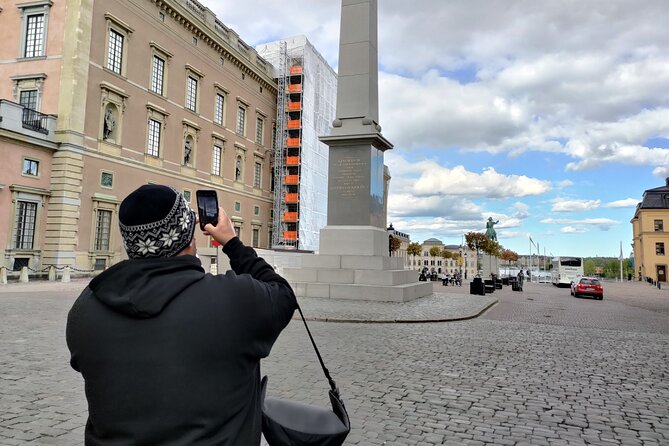
You begin around 9:30 a.m. at the Gustav III Obelisk on Slottsbacken. The route ends at the Vasa Museum, so you do not waste time returning to the starting point. The 4:00 p.m. departure begins outside the Vasa Museum instead and works in the opposite direction, with the museum portion limited by closing time.
That structure matters. If you have only one day in Stockholm, you get a quick orientation, a guided look at the Old Town, a ferry crossing, and the city’s most famous museum. You will not see every major sight, but you will understand how the old center and museum island fit together.
The price is about $135.69 per person. That is not a bargain-priced city walk, but the fee covers a local authorized guide and a one-way ferry ticket. The Vasa Museum admission is not included, so add that cost when comparing the tour with a private guide or a self-guided visit.
Other boat trips out of Stockholm:
- Stockholm: City Archipelago Sightseeing Cruise with Guide
★ 4.3 · 10,798 reviews - Stockholm: Archipelago Boat Tour
★ 4.4 · 3,110 reviews - Stockholm: Highlights Boat Tour
★ 4.3 · 2,542 reviews
Slottsbacken and the Royal Palace area
At the foot of the Gustav III Obelisk, the guide sets the scene. The monument is tied to the story of King Gustav III, including the attack at the Royal Opera that led to his death. It is a useful opening because the tour begins with power, monarchy, and political drama rather than a list of street names.
The Royal Palace is only a short stop, with about five minutes devoted to its history and the Swedish monarchy. You do not tour the palace interiors on this experience, and admission is not included. Instead, you get context before moving deeper into Gamla Stan.
That short palace stop suits a fast orientation tour. If you want royal apartments, state rooms, or a long look at palace collections, plan a separate visit.
A brief stop at the Finnish Church adds another small Old Town detail. These quick pauses are part of the tour’s character. You are not settling into one attraction for an hour. You are collecting stories and landmarks as you move through the historic center.
Stortorget, the Nobel Museum, and Stockholm’s darker stories
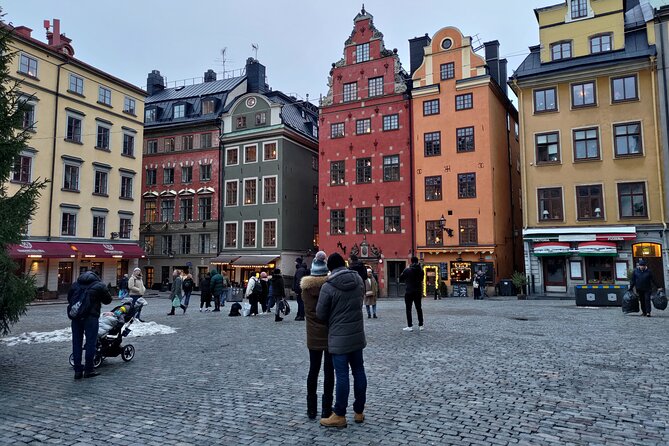
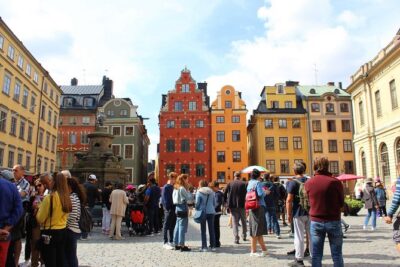
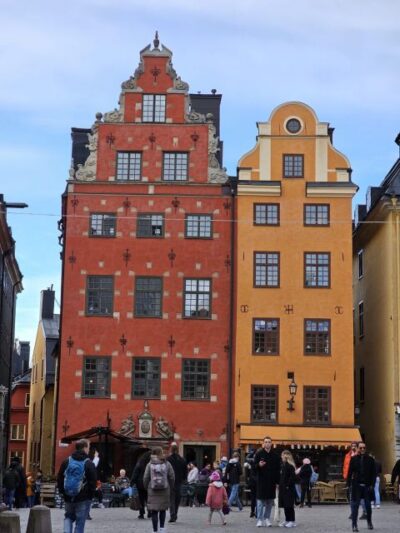
Stortorget is the Old Town’s main square and one of the most atmospheric points on the route. Its colorful 17th-century façades are easy to admire, but the guide also explains the Stockholm Bloodbath, a political massacre that gives the square a much darker past.
You then pass the Nobel Prize Museum. The guide links Alfred Nobel’s life with the square and the wider history of Stockholm. It is a pass-by rather than a museum visit, so do not expect time to see the exhibits inside.
The route becomes more unusual near the old runestone and Prästgatan. The runestone offers a small piece of early Scandinavian history, while Prästgatan, known in translation as the Alley of Hell, leads into stories about executions and the people who carried them out.
This is where a guide adds real value. On your own, you might admire the stonework and narrow lanes without knowing why a particular alley has such a grim name. The stories turn a pretty walking route into a place shaped by crime, punishment, religion, and power.
There is also a short stop at Storkyrkan, Stockholm’s main church. The focus includes archaeological discoveries and what they reveal about daily life in old Stockholm. Again, the church is discussed from the outside rather than treated as a full interior visit.
Riddarholmen and the medieval trading quarter
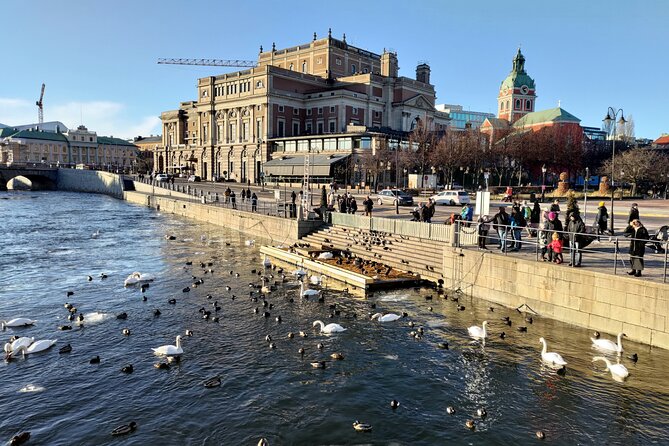
After the central Old Town, the group continues toward Riddarholmen, often called the island of the Nobels. The stop touches on monks, fires, death, and destruction. You also hear about the House of Nobility, another reminder that Swedish history was shaped by social rank as much as by kings.
At Järntorget, or Iron Square, the subject shifts to trade. The guide explains commercial networks, the German influence in Stockholm, and the role the square played in the old town economy.
This part helps balance the royal and religious stories. Stockholm was not only a seat of government. It was also a port city tied to merchants, foreign communities, shipping, and regional trade.
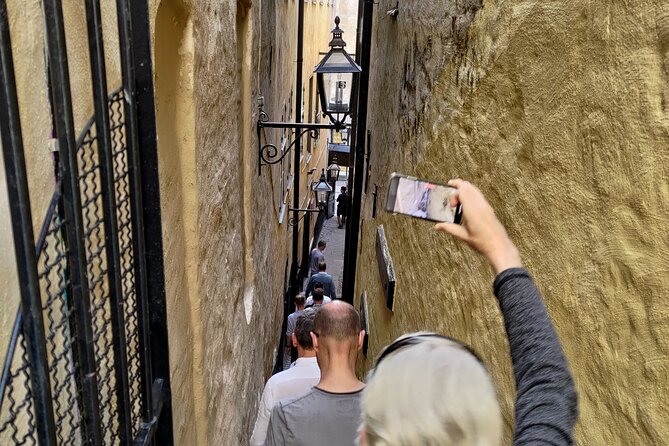
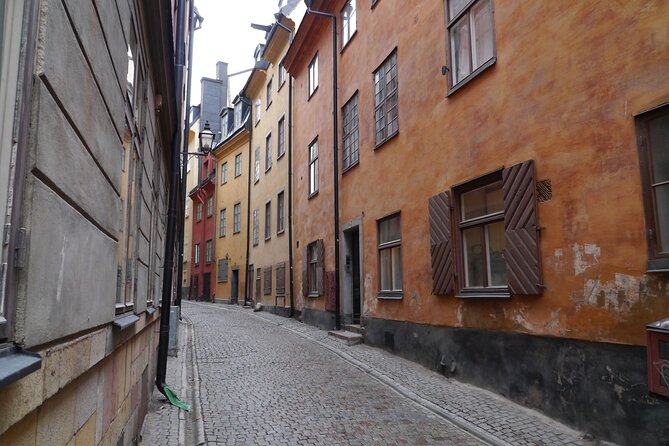
The walk through Mårten Trotzigs gränd is brief but memorable. At its narrowest, this is known as Stockholm’s smallest alley. The guide also tells the tragic story behind its name.
You should expect stops of only a few minutes at several locations. That keeps the route moving, but it also means you will not have much time to photograph every lane or browse shops. If you enjoy lingering over architectural details, return to Gamla Stan later on your own.
Other ways to see the old streets of Stockholm:
- Walking Tour of Stockholm Old Town
★ 5.0 · 1,175 reviews - The Original Stockholm Ghost Walk and Historical Tour – Gamla Stan
★ 4.5 · 1,165 reviews - Stockholm: Old Town Walking Tour with Local Guide
★ 4.7 · 719 reviews - Walking Tour of Stockholm’s Old Town, Gamla Stan
★ 5.0 · 451 reviews
Skeppsbrokajen and the ferry to Djurgården
At the Skeppsbrokajen waterfront, the guide discusses Stockholm’s old harbor, trade routes, and waterways while the group waits for the ferry. The one-way ferry ticket is included.
The crossing is not a long sightseeing cruise, and it should not be treated as one. Its value is practical and visual. You move between two important parts of Stockholm while getting a change of scenery and a brief view from the water.
Before leaving the Old Town side, the route also includes the statue of St. George. The guide connects it with famous medieval battles, adding another layer to the city’s legends and religious imagery.
The ferry segment is one of the tour’s most useful design choices. A standard walking tour might finish in the Old Town and require you to find your own way to Djurgården. Here, the crossing is built into the route, so you arrive at the museum district without arranging another transfer.
Djurgården, the former royal hunting grounds
Djurgården was once royal hunting ground and later served military and naval purposes. Today it is a park and museum island, home to several of Stockholm’s best-known cultural attractions.
The walk across the island is short, around 20 minutes. You pass the Vrak and Viking museums, housed in former Second World War structures built to withstand aircraft bombs. The guide also points out modern runestones near an entrance and explains their connection with the Viking Age.
These are passing points, not full museum visits. You will not have time to tour the Viking Museum or Vrak on this route, so consider returning if either interests you.
The former naval base at Galärvarvet receives another brief stop. You hear about the old base and its later relocation in the 1970s. At the Nordiska Museet, the guide explains the museum’s focus on Nordic life and objects from the 1500s to the present, with particular attention to Swedish culture from the 1800s onward.
The sequence gives you a sense of Djurgården as more than a collection of museums. It is an island shaped by royal leisure, military work, public parks, and cultural institutions.
The Vasa Museum and the ship that sank almost immediately
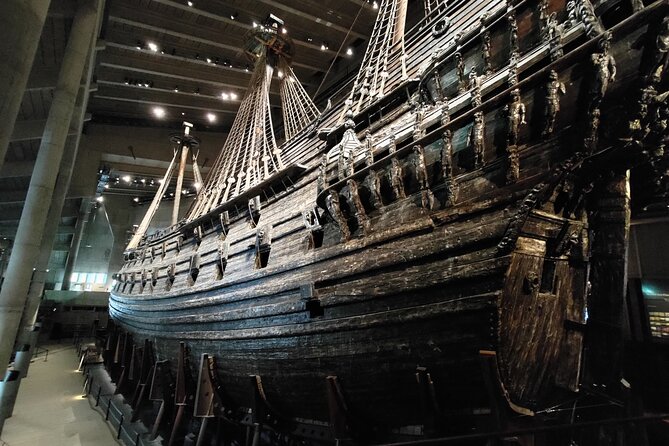
The final stop is the Vasa Museum, and this is the reason many people book the tour. The ship is nearly 40 meters long and retains about 98 percent of its original wooden structure from the 17th century.
Its story is almost too strange to invent. Vasa sailed approximately 1,200 meters before sinking. The museum explains the ship’s construction, the people aboard, the recovery operation, and the preservation work that allows you to see so much of the original vessel.
You spend about 40 minutes with the guide inside the museum on the morning tour. Several guides, including Peter, Karin, Christoffer, and Nicholas, have been praised for their detailed explanations of the ship and its exhibits. One guide, Peter, previously worked at the Vasa Museum, though you should not assume he will lead your departure.
The guide’s role is important here because the ship is enormous and the museum contains more than the vessel itself. You can easily miss the human stories, technical problems, and political ambitions behind it without some direction.
Still, 40 minutes is an introduction, not a full museum visit. If you are fascinated by maritime history, plan to stay after the guided portion if opening hours allow. The morning tour ends at the museum, which makes that easier. You can continue at your own pace rather than being led back across town.
The afternoon departure needs more caution. In the low season, the museum may close at 5:00 p.m., leaving roughly 50 minutes to an hour inside. A delay involving late arrivals once shortened the museum portion further. For that reason, I would choose the morning departure if seeing Vasa properly matters to you.
Guides, group size, and the feel of the walk
The experience depends heavily on who leads it. Named guides associated with this tour include Åsa, Peter, Karin, Tobias, Christoffer, Emma, Nicholas, Olaf, Mike, Cristina, Jawed, Calle, Charlotte, and Af Ki.
The strongest pattern is clear: guides focus on Swedish history, add humor, and answer questions rather than simply reciting dates. Åsa has been especially effective at combining historical detail with present-day Swedish society. Karin is known for an engaging manner and practical care during the walk, ferry crossing, and museum entry. Emma, Tobias, and Christoffer have also been praised for making the history easy to follow.
You cannot choose a specific guide from the information provided, so book this for the structure and subject matter rather than for one individual. The small-group cap of 15 is a real advantage. It allows the guide to respond to questions and keep the group together in tight lanes.
The minimum is three people. If fewer people book, the operator may request an additional payment or cancel and offer another option or a full refund. Some departures may feel almost private when only two couples or a very small number of people attend, but that is not guaranteed.
Walking demands, weather, and practical value
This is a moderate walking experience. You will be outside in all weather, spend time standing, and cross old streets that may be uneven or crowded. Wear comfortable walking shoes and dress for rain, wind, or cool conditions.
The meeting point at the Gustav III Obelisk is central and easy to find. The end point at the Vasa Museum is convenient if you want to continue there, visit another Djurgården attraction, or simply stay on the island.
The tour is offered in English and uses mobile tickets. Service animals are allowed, and the meeting points are near public transportation. Free cancellation is available up to 24 hours before the start time. Changes or cancellations inside that window are not accepted for a refund.
At $135.69, I see the best value for a first visit, a short stay, or a port day when planning time is tight. You are paying for a guide, a carefully linked route, and the ferry transfer, but not for Vasa admission. If you already know Stockholm well, or if you prefer long museum visits and unhurried photography, the schedule may feel too brisk.
Who should book this Stockholm tour?
Book it if you want a strong first look at Stockholm without spending a full day on a single attraction. It suits first-time visitors, people with limited time, and anyone who wants the Old Town explained rather than simply photographed.
Choose the 9:30 a.m. departure if the Vasa Museum is your main goal. You will reach it with more breathing room and can continue exploring after the guided visit.
Skip it if you want a private itinerary, extensive palace interiors, or several hours inside Vasa. A self-guided plan may be better if you already have a firm interest in one museum or prefer to move slowly.
For most first-time visitors, I would book the morning tour. The route gives you Stockholm’s medieval core, a useful ferry crossing, and one of Europe’s most unforgettable museum displays in a single, well-packed outing.
FAQ
How long is the Stockholm Must See tour?
The tour lasts approximately three hours.
Where does the morning tour begin?
The morning tour begins at the foot of the Gustav III Obelisk on Slottsbacken, Stockholm.
Where does the tour end?
The tour ends at the Vasa Museum on Galärvarvsvägen 14, Stockholm.
Is the Vasa Museum ticket included?
No. The Vasa Museum admission ticket is not included, although the experience includes skip-the-line access.
Is the ferry ticket included?
Yes. A one-way ferry ticket to Djurgården is included.
What language is the tour offered in?
The tour is offered in English.
What is the maximum group size?
The group can include a maximum of 15 people.
What happens if fewer than three people book?
The tour requires at least three people to operate. If the minimum is not met, you may be offered another date or experience, or receive a full refund.
More boat trips in Stockholm
- Stockholm Archipelago Cruise with Guide
★ 4.0 · 1,125 reviews - Stockholm: Royal Djurgården Boat Tour
★ 4.1 · 639 reviews - Open Electric Boat Ride in Stockholm with Live-Guide
★ 5.0 · 637 reviews - Stockholm: Guided City Sightseeing Open Electric Boat Tour
★ 4.8 · 516 reviews
More museums in Stockholm
- Stockholm: Skansen Open-Air Museum Admission Ticket
★ 4.5 · 3,427 reviews - Stockholm Pass: Save up to 50% – Includes Vasa Museum Ticket
★ 4.1 · 2,392 reviews - Stockholm: Nobel Prize Museum and Exhibition Entry Ticket
★ 4.3 · 994 reviews - Stockholm: Fotografiska Museum Entrance Ticket
★ 4.5 · 702 reviews
Just added around Stockholm
- World War II Stockholm Old Town Walking Tour and Army Museum★ 4.6 · 4 reviews
- Vaxholm & Stockholm Archipelago: Guided Excursion, Day Trip★ 4.8 · 41 reviews
- Stockholm: Archipelago Guided Boat & Walking Tour of Vaxholm★ 3.1 · 23 reviews
- Wolf and Wildlife Tracking in Sweden★ 5.0 · 9 reviews
- Walking Tour of Stockholm’s City Center★ 4.5 · 26 reviews
- Scandinavian Art, Architecture and Design Tour in Stockholm★ 4.5 · 11 reviews
- Drottningholm Palace Private Guided Tour★ 4.5 · 15 reviews
- ROYAL Castle Skokloster and Viking Sigtuna (private tour)★ 4.5 · 3 reviews
Old Town and Gamla Stan Walks, compared.

The Original Stockholm Ghost Walk and Historical Tour – Gamla Stan
Read our review →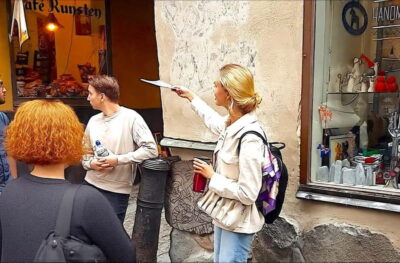

Walking Tour of Stockholm’s Old Town, Gamla Stan
Read our review →
Secrets of Gamla Stan Guided Tour w/ Fika Option
Read our review →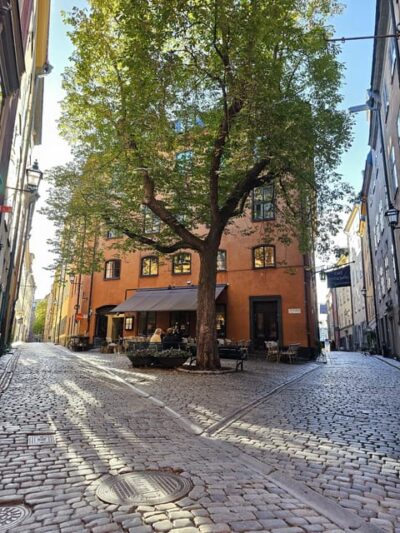
Browse the lists this tour appears in