
Reviewed · WALKING TOURS
Make Your Own Tour – Guided Walking Tour
Gothenburg reveals itself best on foot, and this private tour gives you room to shape the story. You can move from the city’s founding square to its cathedral, fish market, old Haga streets, and hilltop Masthuggskyrkan without being tied to a fixed group script. The guide adapts to your interests, which is especially useful if you care more about local history, food, architecture, or city views.
I like the flexible start time and the chance to ask questions as you go. I also like the mix of major sights and odd little places, including Queen Christina’s Hunting Lodge and Tomtehuset. The main drawback is the listed price of $735.72 per person, which is very high for a short walking tour, even though group discounts and free admission for children may improve the value for some bookings.
Key points to know before booking
- Private and adjustable: Your group gets its own guide, with the route adapted to your wishes.
- A broad Gothenburg sampler: The walk links Gustav Adolfs Torg, Feskekorka, Haga, Masthuggskyrkan, and Gotaplatsen.
- Christina may be your guide: One highly praised experience names Christina as friendly, punctual, and well prepared.
- The route includes both landmarks and oddities: Expect stories around city founders, old walls, myths, churches, markets, and unusual houses.
- The timing needs clarification: The stated duration is 1.5 to 2 hours, but the listed stop times add up to much longer.
- Extra costs remain: Coffee, public transportation, and museum admission are not included.
A private walk through Gothenburg’s many faces
This is not simply a march between postcard sights. The route tries to show how Gothenburg grew, changed, and sometimes left strange traces behind. You begin at Gustav Adolfs Torg, pass through the old center, head toward Haga and its hilltop church, then finish at Gotaplatsen before returning to the meeting point.
That range is the tour’s best feature. You get civic history at the main square, religious history at Göteborg Domkyrkan, food culture at Stora Saluhallen and Feskekorka, old neighborhood stories in Haga, and a broad city view from Masthuggskyrkan.
Because the tour is private, you can ask the guide to spend more time on the subjects that interest you. If you want a quick orientation, the guide can keep moving. If you care about Gothenburg’s difficult past or its unusual buildings, you have a better chance of getting the context that a standard group walk may skip.
The experience is offered in English, and the meeting point is easy to identify at Gustav Adolfs Torg. The tour starts at 11:00 am and ends back at the same square. It is near public transportation, though tickets for buses or trams are your responsibility if they are needed.
Other guided walks around Gothenburg:
- Gothenburg: Haga Old Town Walking Tour
★ 4.5 · 205 reviews - Gothenburg Private Walking Tour with a Local
★ 4.0 · 36 reviews - Best of Gothenburg: Private Walking Tour with a Local
★ 4.6 · 24 reviews
Gustav Adolfs Torg and the city’s founding story
The first stop is Gustav Adolfs Torg, Gothenburg’s main square. A statue of the city’s founding father gives the square its focus and provides a natural starting point for learning how Gothenburg began.
This is a useful opening because the guide can establish the city’s basic story before taking you into its streets. You are not just looking at a statue. You are getting a reference point for the rest of the walk, especially when later stops touch on old defenses, city growth, and the people connected with Gothenburg’s foundation.
The planned time is 15 minutes, with no admission charge. That is enough for an introduction and questions, though anyone hoping for a long historical explanation may need to ask for more time.
Göteborg Domkyrkan and a difficult religious past
Göteborg Domkyrkan is described as Gothenburg’s oldest cathedral, and the tour gives it about 15 minutes. Its importance comes not only from age but also from its difficult history.
A church stop can easily become a quick photograph, so this is a place where the guide’s storytelling matters. Ask about the events that shaped the cathedral and the challenges it faced. The supplied details do not specify those events, so the most useful approach is to let your guide explain them rather than expect a full museum-style presentation.
Admission is free. The stop adds depth to the walk by showing that Gothenburg’s story is not only about trade, streets, and public squares. Religious buildings often carry the record of fires, changes, conflict, and rebuilding, and this cathedral is presented as an important example.
Saluhallen and the taste of Swedish food
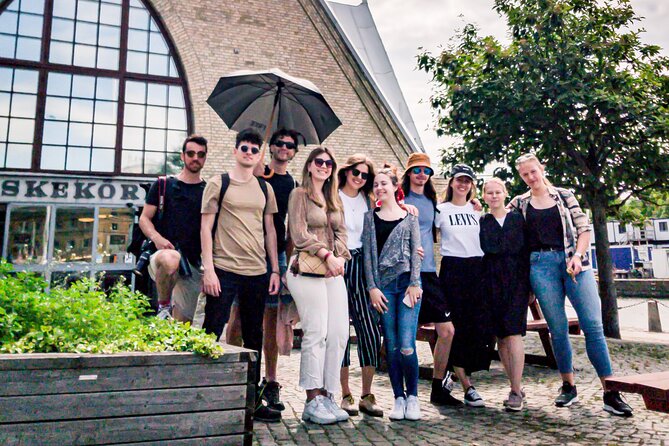
Stora Saluhallen is Gothenburg’s large market hall, with Swedish delicacies available to try. The planned stop is only five minutes, so treat this as a quick introduction rather than a full food tour.
I would ask the guide which local foods are most worth noticing before you spend anything. Coffee and tea are not included, and any food purchase would also be your responsibility. That gives you freedom, but it also means you should not assume tasting is built into the tour price.
The hall is a practical place to add a food angle to a history walk. You can see how local eating fits into daily city life, then decide if you want to return later for a slower visit. If food is a main reason for booking, ask in advance for extra time here.
Same city, a completely different afternoon:
- Gothenburg: Archipelago cruise with guide
★ 4.3 · 1,002 reviews - Gothenburg: City Canal Sightseeing Cruise
★ 4.7 · 470 reviews - Gothenburg: Go City All-Inclusive Pass with 20+ Attractions
★ 3.8 · 222 reviews - Gothenburg: City Sightseeing Hop-On Hop-Off Bus Tour
★ 3.8 · 206 reviews
Karl IX, vanished walls, and the old city edge
The equestrian statue of Karl IX marks the place where Gothenburg’s city walls once stood. It is also tied to another founding father of the city.
This stop makes the old city easier to understand. Walls are often invisible now, but a guide can help you picture the boundary that once shaped movement and defense. The statue gives you a physical marker for that lost edge.
The planned time is 15 minutes. Like the cathedral, it is most valuable when you ask questions. The supplied details do not promise preserved fortifications, so you should expect explanation and location rather than a walk through intact walls.
Queen Christina’s Hunting Lodge and Gothenburg’s odd side
Drottning Kristinas Jaktslott, or Queen Christina’s Hunting Lodge, is presented as one of Gothenburg’s oddities, with plenty of myths attached to it. That makes it a welcome change from the city’s formal monuments.
The appeal here is the story. A small or unusual building can reveal how a city remembers its past, including the legends that collect around old places. Since the tour specifically calls attention to myths, ask the guide which parts are documented and which belong to local storytelling.
The planned stop is 15 minutes. It is a good example of why a private walk can be more interesting than a checklist of famous sights. You get a detail that might otherwise be easy to pass without noticing.
Feskekorka and Gothenburg’s fish-market identity
Feskekorka is one of Gothenburg’s best-known landmarks and a traditional fish market. Its name is commonly associated with a church, and the building’s unusual form is part of its appeal, though the provided tour details focus on its landmark status and fish market.
The stop lasts about 10 minutes. That is enough to see the exterior and hear why it matters, but not enough for a long market visit or a leisurely meal. If seafood is important to you, ask whether the timing can be adjusted.
This stop adds a strong local flavor to the route. Gothenburg is a port city, and a fish market connects the built city with the food traditions that have shaped it. You may want to return independently if you hope to browse carefully.
Akademibokhandeln and an old connection point
Akademibokhandeln is described as one of Gothenburg’s main connection points in the 19th century. Today, the area is associated with nightlife, cafés, and access to places where you can take a break.
The planned visit is 15 minutes. This is less about one grand monument and more about how city spaces change use over time. A place that once connected people in the 19th century now helps connect you with cafés and evening activity.
That makes it a useful stop for practical orientation. If you want advice on where to pause after the tour, this is a sensible moment to ask the guide. Still, the tour does not include coffee or tea, so any café stop is extra.
Masthuggskyrkan and the best city view
Masthuggskyrkan is the route’s major uphill stop. The church sits on a hill and offers a great view over Gothenburg. The planned time is 30 minutes, making it the longest single stop listed.
The extra time makes sense. You need a moment to take in the view, and the church itself is part of the experience. This is one of the strongest reasons to choose a walking tour rather than rely only on a vehicle. The climb and viewpoint help you understand the city’s shape from above.
The tour details do not state how difficult the hill is, so ask the provider if mobility is a concern. Most people can participate, and service animals are allowed, but the route includes an elevated church setting and should be considered when planning for anyone who finds hills difficult.
Haga Nygata, dark stories, and Swedish fika
Haga Nygata is one of Gothenburg’s most familiar districts, but the tour does not present it as only a pretty shopping street. It also has a darker history, which gives the neighborhood more weight than its cafés and old-style appearance might suggest.
The planned time is 35 minutes, the longest stop on the route. This is where you can slow down, hear the neighborhood’s story, and take a Swedish fika, the traditional coffee break. Coffee and tea are not included, so budget separately for your drink and any pastry.
I like the balance here. You get history, local atmosphere, and a chance to rest. It is also a good place to tell the guide what you want from the final part of the walk. If you prefer architecture and cafés over monuments, Haga may become your favorite section.
Haga Church and Tomtehuset’s unusual detail
The Haga Church is described as the area’s first neo-Gothic church, with a beautiful wooden interior. The planned stop is 10 minutes.
That short visit should give you a look inside and a quick explanation of the church’s place in Haga. The wooden interior provides a contrast with the stone and civic landmarks seen earlier. Admission is listed as free.
Tomtehuset follows with only five minutes. It is another Gothenburg oddity, located right beside the streets. The short stop suggests a quick look and a story rather than a long visit. These two stops work well together because they keep the route from becoming predictable.
Poseidon and the final stop at Gotaplatsen
Gotaplatsen is home to Poseidon, one of Gothenburg’s best-known landmarks. It is also a place for many city activities, giving the tour a final public square where art, gatherings, and city life meet.
The planned time is 15 minutes. This is a good closing point because it brings you back to a major civic setting after the smaller streets of Haga. The tour then returns to Gustav Adolfs Torg, the starting point.
The listed route is ambitious. The stated experience lasts about 90 minutes to 2 hours, but the stop times add up to more than three hours if every stop receives its full allocation. That does not make the tour unusable, but you should confirm how much of the route will fit into your booking and which stops receive priority.
Is the $735.72 price worth it?
At $735.72 per person, this is expensive for a walk lasting approximately 1.5 to 2 hours. The price needs careful thought, especially because coffee, public transportation, and museum entrance fees are extra.
The strongest value comes from privacy and flexibility. You are paying for a guide who adapts to your group, not just for access to free public sights. Children and infants join free, and group discounts are available, so the per-person price may work differently depending on the size and makeup of your booking.
Still, I would not book without checking the total price for your exact group. Ask how the group discount applies, how many stops can realistically fit, and whether the guide can focus on your priorities. A private guide is more valuable if you want personal attention, detailed questions, or a custom route. It is harder to justify if you only want a quick overview of Gothenburg’s main sights.
Who will enjoy this Gothenburg walk?
I would recommend it most to:
- Families who want a private pace and free participation for children
- First-time visitors who want an orientation across several parts of the city
- History-minded visitors interested in founders, old walls, churches, and difficult chapters
- People who prefer walking and conversation to a large scheduled group
- Anyone who wants Haga, Feskekorka, Masthuggskyrkan, and city-center landmarks in one experience
It may not suit you if you want a low-cost tour, a dedicated food experience, or a long museum visit. It also may not suit you if you need a completely flat route, since Masthuggskyrkan is on a hill and the tour is on foot.
The private format is the clearest advantage. A highly praised booking specifically notes Christina’s friendly manner, good preparation, punctual arrival, and clear plan based on the group’s interests. That is exactly what you should hope for here, but ask for Christina by name only if the provider confirms her availability.
Should you book Make Your Own Tour?
Book it if you value a private guide and want Gothenburg explained through a mix of famous sights, local food places, churches, myths, and unusual corners. The free cancellation policy also gives you flexibility if you cancel at least 24 hours before the start time. Poor weather may lead to a new date or a full refund.
Before paying, confirm the final cost, group discount, realistic duration, and route priorities. The advertised stop schedule is longer than the stated tour length, and the high price demands clear expectations.
For a family or private group that wants a tailored introduction, this can be a worthwhile splurge. For a solo visitor or budget-conscious couple, I would compare the cost carefully with shorter public walks before booking.
FAQ
Where does the walking tour begin?
The tour begins at Gustav Adolfs Torg, also called Gustav Adolf’s Square, in Nordstaden, Gothenburg.
What time does the tour start?
The stated start time is 11:00 am.
Where does the tour finish?
The activity ends back at the meeting point at Gustav Adolfs Torg.
How long does the tour last?
The stated duration is approximately 1 hour 30 minutes to 2 hours.
Is the tour private?
Yes. Only your group participates in the activity.
Is the tour offered in English?
Yes. English is the listed language.
Are children and infants allowed to join?
Yes. Children and infants join for free.
Are museum entrance fees included?
No. Museum entrance fees are not included if you choose to visit a museum.
Can I cancel for a refund?
Yes. You can cancel at least 24 hours before the local start time for a full refund. Cancellations made less than 24 hours before the start time are not refunded. If poor weather causes the tour to be canceled, you will be offered another date or a full refund.
Just added around Gothenburg
- Gothenburg: Alfie Atkins Cultural Centre Admission Ticket★ 4.2 · 12 reviews
- GOT Gothenborg Landvetter Airport: Vinga Lounge Access★ 3.5 · 52 reviews
- Entry Ticket To Gothenburg Museum of art with pickup★ 4.4 · 4 reviews
- Gothenburg: Express Walk with a Local in 60 minutes★ 4.8 · 6 reviews
- Gothenburg: 24 Hour Hop On–Hop Off Bus and Boat Tour★ 4.3 · 37 reviews
- Gothenburg Private Walking Tour with a Local★ 4.0 · 36 reviews
- Best of Gothenburg: Private Walking Tour with a Local★ 4.6 · 24 reviews
- Gothenburg city center: Electric selfdrive boat tour★ 4.4 · 50 reviews
Walking Tours, compared.
The Original Stockholm Ghost Walk and Historical Tour – Gamla Stan
Read our review →
Best of Stockholm Walking Tour-3 Hours, Small Group max 10 people
Read our review →
Walking Tour of Stockholm’s Old Town, Gamla Stan
Read our review →
Browse the lists this tour appears in