

Reviewed · GHOST AND DARK HISTORY WALKS
Guided Ghost Tours with Actors From Stockholm
Stockholm’s Old Town gets a theatrical after-dark treatment on this one-hour walk. A guide in 18th-century costume leads you through narrow lanes while actors appear as figures from the city’s past, including an executioner, architect Nicodemus Tessin, and the notorious Jacob Johan Anckarström. You hear about plague, executions, royal ghosts, and the 1520 Stockholm Bloodbath.
I like the compact route, which links several memorable Old Town places without taking up an entire evening. I also like the interactive storytelling, which gives the history a human face rather than turning the walk into a plain lecture. The main drawback is that the tour moves quickly, with roughly five minutes at each stop and no seats, so it suits you best if you enjoy walking and theatrical presentation.
Key points to know before you book
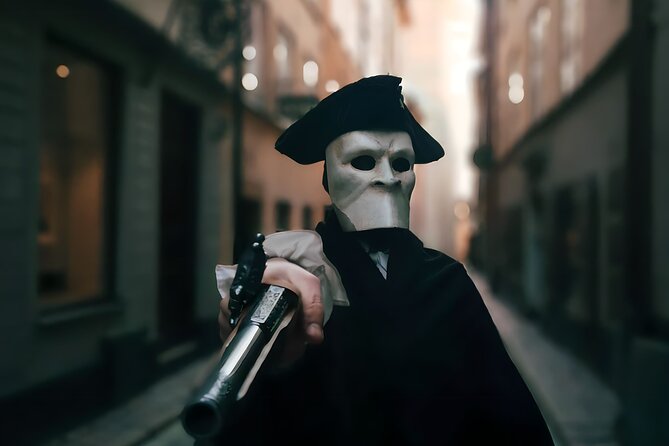
- Eight Old Town stops in about one hour: The route covers Köpmantorget, Stortorget, Prästgatan, Spektens Gränd, the Royal Palace, and other atmospheric lanes.
- Actors play historical figures: You may meet an executioner, Nicodemus Tessin, and characters linked to Stockholm’s darker past.
- A 7:30 pm start: The evening timing fits neatly before or after dinner, and the darker setting suits the ghost stories.
- Rhys is one guide name connected with the experience: The guide’s delivery is central, since the tour depends more on storytelling than on museum displays.
- No seats and a maximum of 35 people: You explore on foot in a fairly small group, but expect to stand at each stop.
- The price is $37.32 per person: That is fair for a short, actor-led city walk, though it is not a bargain if you want detailed sightseeing at every location.
A theatrical walk through Stockholm’s oldest lanes
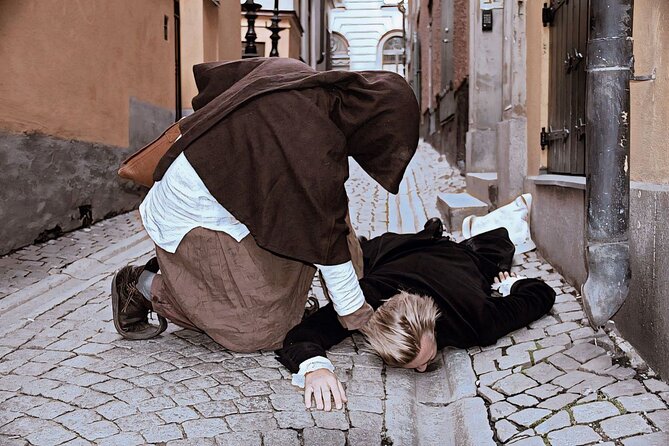
This is not a haunted-house attraction with elaborate sets. The setting is Stockholm itself, especially the Old Town, where narrow streets, old squares, churches, and palace walls provide the backdrop. The actors add drama, but the facts are tied to real people and real events.
That balance matters. You get an entertaining evening, yet the stories introduce some of Stockholm’s hardest chapters: war with Denmark, mass executions, plague, poverty, imprisonment, and royal tragedy. The ghost stories work best when you understand the events behind them.
The tour starts at Köpmantorget at 7:30 pm. You meet the group near the statue of Saint George and the dragon, then move through the Old Town on foot. The activity ends back at the starting meeting point after the final stop at Bollhusgränd.
The group can include up to 35 people. That is large enough to give the walk energy, but small enough that a costumed actor should remain visible in the narrow streets. Still, do not expect a private performance. If you prefer quiet, detailed conversation with a guide, the theatrical style and group size may feel less personal.
Other after-dark walks around Stockholm:
- Stockholm: Ghost Walk and Historical Tour
★ 4.7 · 2,206 reviews - The Original Stockholm Ghost Walk and Historical Tour – Gamla Stan
★ 4.5 · 1,165 reviews - Bloody Stockholm 2h – ghosts, horror and Dark Folklore Tour
★ 5.0 · 14 reviews
Köpmantorget and the legend of Saint George
The opening stop is Köpmantorget, an old market square connected to Köpmangatan, considered Stockholm’s oldest named street. The street was first mentioned in 1323 and served as a merchants’ route.
The statue of Saint George and the dragon gives the guide an easy way into Stockholm’s medieval past. In this Swedish telling, the familiar European hero story also represents Sweden’s victory over the Danes in 1471.
You spend only about five minutes here. That is enough for the basic story and a look at the statue, but not enough for a long explanation of medieval Stockholm. I would treat this as an opening scene, not a full architectural stop.
The statue also sets the tone for the evening. The tour uses familiar places as stages, then adds legends and historical characters. You are not simply hearing about ghosts in the abstract. You are standing beside the objects and streets connected with each story.
Stortorget and the 1520 Stockholm Bloodbath
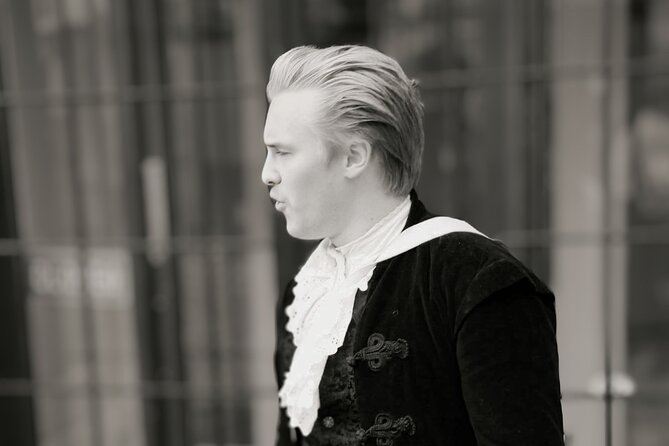
Next comes Stortorget, Stockholm’s best-known square. Its colorful buildings and central location make it one of the Old Town’s most photographed places, but the tour focuses on a far darker event: the Stockholm Bloodbath of 1520.
The guide explains how one of the cruelest episodes in Stockholm’s past unfolded here. The story centers on executions and political violence after the Danish conquest of Sweden. The tour may also suggest that the executioner is still close by, turning the historical account into a live scene.
This is one of the strongest stops because the square already has a clear sense of place. You can connect the account to the exact space around you instead of trying to picture an event in a distant museum gallery.
The stop lasts about five minutes. That keeps the tour moving, but it also means the explanation is likely to be selective. If you want a detailed account of the political background, names, and aftermath of the Bloodbath, you will need another source or a longer history tour.
Prästgatan and the plague years
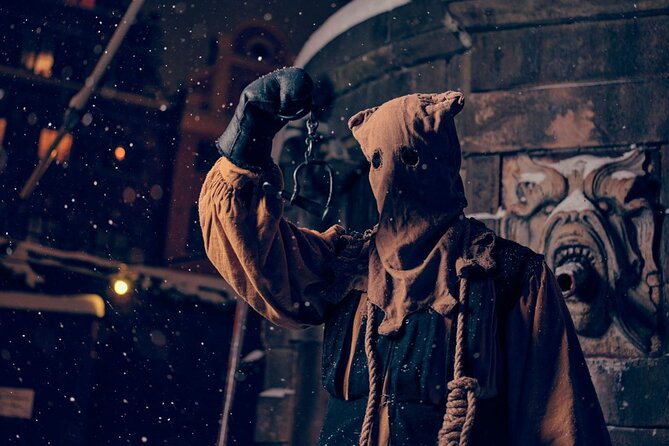
The route then reaches Prästgatan, a street whose name comes from the Swedish word for priest. The area had strong ties to the church and was once associated with Stockholm’s poor district.
Here the story shifts from political killing to disease. The guide discusses the plague that reached the city in 1350, giving you a glimpse of what illness meant in a crowded medieval town.
This stop brings a useful change of mood. The earlier stories involve rulers, battles, and executions. Prästgatan brings the focus to ordinary people, poverty, fear, and the limits of medical knowledge.
Again, expect about five minutes. You will get the dramatic outline rather than a full study of the plague. The value lies in hearing the story in the old street itself, where the guide can connect the setting with the people who once lived there.
Other guided tours around Stockholm:
- Stockholm: City Archipelago Sightseeing Cruise with Guide
★ 4.3 · 10,798 reviews - Stockholm Archipelago Cruise with Guide
★ 4.0 · 1,125 reviews - Stockholm: Old Town Walking Tour with Local Guide
★ 4.7 · 719 reviews - Open Electric Boat Ride in Stockholm with Live-Guide
★ 5.0 · 637 reviews
Spektens Gränd and Stockholm’s most haunted street
At Spektens Gränd, the guide continues the plague story and links it to Prästgatan, described during the walk as the most haunted street in the Old Town.
This part relies more heavily on atmosphere and reported sightings than on a single famous event. You hear accounts of strange experiences in the neighborhood and how the plague shaped the local memory of the streets.
For you, this may be one of the more effective sections if you enjoy ghost stories that grow from real places. The lanes are close together, and the short pauses let the guide build a connected story rather than presenting eight unrelated tales.
The trade-off is that the supernatural material is presented as legend. You should book this for the pleasure of storytelling, not as proof of paranormal activity. The tour keeps the mood playful and dramatic, but the historical parts are easier to assess than the ghostly ones.
The prison story of Jacob Johan Anckarström
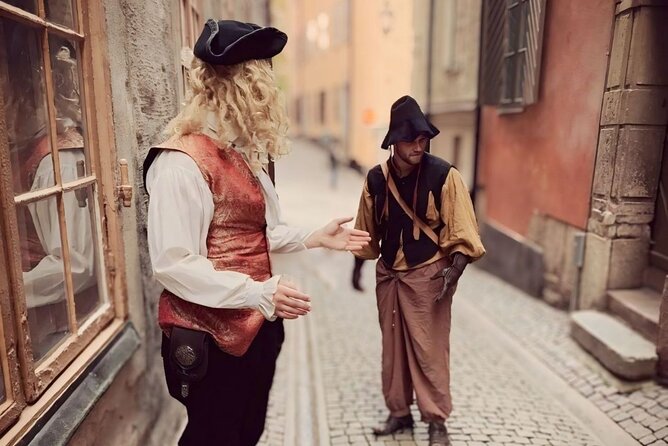
The walk continues through the Old Town to the site associated with Stockholm’s famous prison. Here you hear about Jacob Johan Anckarström, the king slayer who spent his last days in confinement before his execution.
The story does not end with his death. According to the legend shared on the tour, his shuffling footsteps can still be heard in the lanes after his execution. An actor or guide may bring this account to life, giving the scene a personal face rather than presenting Anckarström as a name in a textbook.
This stop works well for visitors who want political history with a ghost-story ending. It also shows how the tour moves between documented events and later folklore.
The five-minute pause is enough to establish the character and the haunting. It is not enough to explain every detail of the assassination, the legal process, or the wider political crisis. Think of the walk as an introduction to these stories, with the added pleasure of seeing the streets connected to them.
Helvetesgränd and the executioner
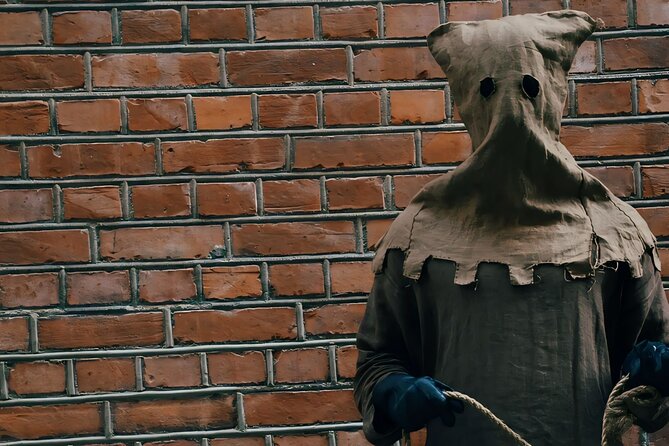
The next stop is Helvetesgränd, whose name means Street of Hell. The name alone gives the guide a strong opening, and the setting is tied to another grim part of Old Town life: the executioner once lived here.
At this point, you meet the executioner as a character. He tells stories about executions, his own life, and how he came to take up the job. This role is a good example of what separates the tour from a standard walking tour. Instead of only hearing about an occupation, you encounter a performer presenting the person who carried it out.
The subject matter can be heavy. Executions were public events, and the stories may not suit young children or anyone who dislikes macabre detail. The presentation is theatrical, but the underlying history is not light.
You spend about five minutes here. That short pause keeps the pace brisk and prevents the evening from becoming oppressive. It also means the executioner’s character will likely be remembered more for mood and storytelling than for a full social history of punishment in Sweden.
The Royal Palace and the White Lady
The Royal Palace provides one of the tour’s most recognizable settings. Here you meet Nicodemus Tessin, the architect associated with the royal castle and a figure from continental Europe.
His story covers the palace, the great castle fire, and the White Lady, often described as one of Sweden’s most frightening ghosts. According to the legend, a pale female figure has been seen on the top floor of the castle by members of Swedish royalty and ordinary people.
This is a strong late-tour stop because it brings together architecture, royal history, disaster, and folklore. The palace gives the story a grand backdrop, while the White Lady provides the ghostly payoff.
Do not expect entry into the Royal Palace. The activity is an outdoor walking experience, and the information provided places you around the palace rather than inside it. If seeing the royal rooms is important to you, plan a separate visit.
The palace stop also shows the tour’s range. The route has already covered merchants, plague victims, prisoners, and executioners. Here, the focus shifts to royalty and one of Stockholm’s best-known apparitions.
Bollhusgränd and the Little Iron Boy
The final stop is Bollhusgränd, near the Finnish Church and Sweden’s smallest statue, the Little Iron Boy. The statue is tiny enough to be easy to miss if you are walking through the Old Town on your own.
The guide shares the sad story connected with the boy and explains the belief that you can make a wish at the statue. This gives the tour a softer ending after the stories of executions, disease, and political violence.
You have about five minutes here to hear the final tale, take photographs, and ask questions. The guide and executioner are available for pictures, which gives you a chance to interact with the performers after the formal route ends.
Because the activity finishes here, the ending feels more personal than a simple goodbye in an open square. You leave with one small statue and one gentle superstition, rather than ending on the most frightening story of the evening.
What the $37.32 price buys you
At $37.32 per person, this is not the cheapest way to walk around Stockholm. You are paying for a one-hour guided performance, a costumed guide, several actors or character appearances, and a route that links eight places in the Old Town.
The value depends on how you like to learn. If you want a guide to explain buildings, dates, and architecture in detail, a traditional walking tour may offer more information for a similar price. If you want an entertaining evening with historical material and live characters, the price is easier to justify.
The tour also covers a lot of ground in a short time. One past participant described the experience as covering a lot of ground and praised the commentary from Rhys, with the spelling of the name uncertain in the available details. That makes good pacing important. You are not paying for long stops at each site. You are paying for a connected performance that keeps moving.
Dinner is not included. Food can be added to the booking, with a reservation at a restaurant serving traditional Swedish dishes. Treat that as a separate cost and check the details before assuming it is part of the tour price.
Practical details that affect your evening
The meeting point is Köpmantorget, 111 31 Stockholm, Sweden. The activity begins at 7:30 pm and ends back at the meeting point.
You will be on your feet for the full hour. There are no seats, and each stop lasts about five minutes. Wear comfortable shoes and expect to walk through Old Town streets rather than wait in one location.
The tour is near public transportation, and service animals are allowed. Most people can participate, but anyone who needs regular seating should consider the lack of chairs before booking.
A mobile ticket is provided, and confirmation arrives at booking. Free cancellation is available up to 24 hours before the start time. A cancellation within 24 hours is not refunded, and changes inside that period are not accepted.
The activity requires a minimum number of people. If that number is not reached and the tour is canceled, you are offered another date or experience, or a full refund.
Who will enjoy this ghost tour most
I would recommend this walk to you if you like history served with a bit of theater. It suits couples, friends, and families with older children who are comfortable with stories about plague and execution.
It is also useful early in your Stockholm stay. The route introduces several Old Town lanes and squares, so you can return later with more time to look around. The tour will not replace a full historical walk, but it can help you recognize places and choose which ones deserve a second visit.
You may want a different experience if you dislike ghost stories, want extensive historical detail, or prefer a slow pace with time for photographs. The five-minute stops are deliberately brief, and the actors are part of the appeal. You need to enjoy performance as much as factual explanation.
The current rating is 4.3 from eight ratings. That is a positive result, but the sample is small. The strongest praise focuses on entertaining commentary, the amount of ground covered, and the use of two guides playing historical characters. The interactive element is described as present but not overwhelming, which is useful if you want participation without being forced into a major role.
Should you book Guided Ghost Tours with Actors From Stockholm?
Book it if you want a lively introduction to Stockholm’s Old Town after dark, with real historical events wrapped in ghost stories and actor-led scenes. The Bloodbath at Stortorget, the executioner at Helvetesgränd, the White Lady near the Royal Palace, and the Little Iron Boy give the route a good mix of grim, grand, and gentle stories.
Skip it if you want a long, scholarly explanation of Stockholm or a proper palace visit. At one hour, this is a brisk performance walk, not a full history course.
For most visitors, the deciding question is simple: do you want to stand in old streets while a costumed character tells you what happened there? If yes, the $37.32 price is reasonable, especially for an evening activity that combines sightseeing, local legends, and live entertainment.
FAQ
Where does the ghost tour start?
The tour starts at Köpmantorget, 111 31 Stockholm, Sweden.
What time does the activity begin?
The tour begins at 7:30 pm.
How long does the tour last?
The experience lasts approximately one hour.
Where does the tour finish?
The activity ends back at the meeting point, with the final stop at Bollhusgränd near the Finnish Church.
Is dinner included?
No. Dinner is not included, though you can add food to the booking and reserve a restaurant serving traditional Swedish dishes.
Do I need to sit during the tour?
No seats are provided. You explore the Old Town on foot and stand at each stop.
Can I cancel for a full refund?
Yes. You can cancel at least 24 hours before the start time for a full refund. Cancellations within 24 hours are not refunded.
Just added around Stockholm
- World War II Stockholm Old Town Walking Tour and Army Museum★ 4.6 · 4 reviews
- Vaxholm & Stockholm Archipelago: Guided Excursion, Day Trip★ 4.8 · 41 reviews
- Stockholm: Archipelago Guided Boat & Walking Tour of Vaxholm★ 3.1 · 23 reviews
- Wolf and Wildlife Tracking in Sweden★ 5.0 · 9 reviews
- Scandinavian Art, Architecture and Design Tour in Stockholm★ 4.5 · 11 reviews
- Drottningholm Palace Private Guided Tour★ 4.5 · 15 reviews
- Walking Tour of Stockholm’s City Center★ 4.5 · 26 reviews
- ROYAL Castle Skokloster and Viking Sigtuna (private tour)★ 4.5 · 3 reviews
Ghost and Dark History Walks, compared.
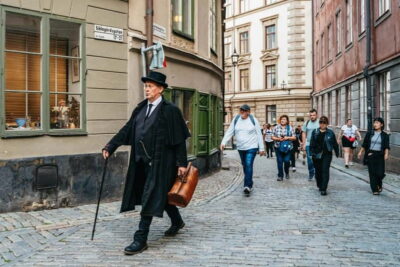
The Original Stockholm Ghost Walk and Historical Tour – Gamla Stan
Read our review →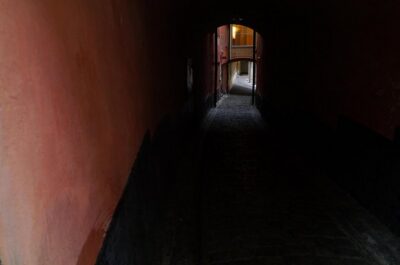
Bloody Stockholm 2h – ghosts, horror and Dark Folklore Tour
Read our review →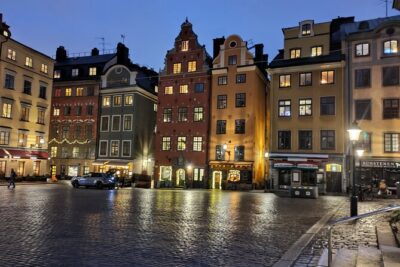
Private blood, ghosts and folklore Old Town 2h Stockholm tour
Read our review →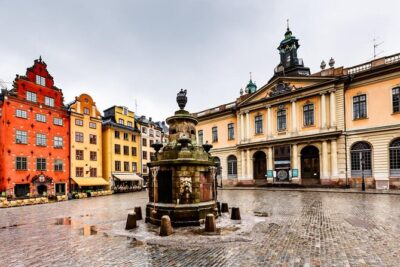
Stockholm Ghost Hunt: Self-Guided Tour and Puzzle Adventure
Read our review →Browse the lists this tour appears in